

A Practice-Based Study of Computational Action in Japanese Public High Schools
Takahiro Yatsu1, Ayaka Nagai1, Rei Takei1, David Kim2
Irodori Inc.1
MIT CSAIL2
Email: {yatsu,ayaka,rei}@irodori-group.jp, dyjkim@mit.edu
Abstract
Japanese high school education mandates inquiry-based learning (“Period for Inquiry-Based Cross-Disciplinary Study”), but practical implementation often faces challenges, leading to superficial learning experiences. In response, we designed and implemented Wagamama Lab, an inquiry-based app development program utilizing MIT App Inventor. This program connects Constructionism and Computational Action, guiding students to start with a “one person’s wish” to define problems, prototype solutions, and engage in iterative improvement and dialogue. This practice was implemented for all first-year students at Ibaraki Prefectural Hokota Daiichi High School (one year) and Ishikawa Prefectural Hakui High School (three months). The results show that students developed applications centered on highly specific, personal concerns (“Wagamama”) related to family/intergenerational support, peer-to-peer optimization, and community logistics. Wagamama Lab demonstrates a pathway for developing deep, practical inquiry in large-scale public school environments, serving as a concrete case study for integrating Constructionism and Computational Action into real school conditions.
Introduction
In recent years, Japanese high school education has placed increasing emphasis on developing students’ ability to formulate their own questions, identify issues in relation to real society and everyday life, and work collaboratively with others toward solutions. This direction has been institutionalized in the national high school curriculum guidelines as the “Period for Inquiry-Based Cross-Disciplinary Study [1].” Through cross-disciplinary learning, students are expected to develop the ability to identify issues, use information, make judgments, express their ideas, and create new value. This “Period for Inquiry-Based Cross-Disciplinary Study” is not an extracurricular activity, but a formal required component of high school education in Japan.
However, the institutionalization of inquiry-based learning does not automatically lead to deep learning in practice. In schools, inquiry-based learning can easily become superficial or formalistic due to factors such as teachers’ limited time, insufficient collaboration with external partners, and a lack of knowledge and support systems for inquiry-based learning [2]. As a result, students do not always reach the stage of identifying issues on their own, designing and implementing solutions, testing them, and improving them. This gap in implementation is an important challenge in inquiry-based learning in Japan.
In response to this challenge, we have designed and implemented Wagamama Lab, an inquiry-based app development program using MIT App Inventor. This program is structured around a learning process in which students begin with “one person’s wish,” examine the difficulties and wishes of people close to them, define problems, create app prototypes, receive feedback, and improve their ideas.
The significance of this practice lies in connecting Constructionism, Computational Action, and self-efficacy within a coherent learning process in regular public school classes. Constructionism provides the foundation for learning through the creation of meaningful artifacts [3]. Computational Action extends that making into action that responds to the needs of real people and society [4]. The experience of prototyping, testing, improving, and engaging in dialogue with others helps students develop a sense that their own ideas and actions can have real value, leading to greater self-efficacy. In other words, this program does not merely describe the theoretical connection as an ideal; it makes that connection concrete through classroom practice.
This paper focuses on Wagamama Lab practices at Ibaraki Prefectural Hokota Daiichi High School and Ishikawa Prefectural Hakui High School. In both schools, the program was implemented based on the same educational philosophy, while being adapted to each school’s class hours and annual schedule. At Hokota Daiichi High School, the program was implemented as a long-term program over approximately one year. At Hakui High School, it was implemented as a short-term intensive program over approximately three months.
Wagamama Program Schedule
The Wagamama Lab program is a program that connects inquiry-based learning with app development, starting from “one person’s wish.” In this program, students use the textbook Local STEAM: Inquiry Through Computational Action [5] to gradually examine the wishes and difficulties of people close to them, deepen their understanding of the issue, and develop app prototypes using MIT App Inventor.
This textbook is not simply a manual for how to create apps. It is structured in stages, including introduction, the basics of App Inventor, persona setting, problem setting, interviews, UI design, prototyping, testing, improvement, and final presentation. Through this structure, students are encouraged to think not only about what they will create, but also about who they are creating it for, why it is needed for that person, and in what situation it will be used.
The basic flow of the program can be summarized as follows. First, in the inquiry guidance session, students learn about STEAM and Computational Action in the context of the Period for Inquiry-Based Cross-Disciplinary Study, and they begin to see technology as a means to take action for society and for people around them. Next, using persona cards and worksheets, students make “one person’s wish” more concrete. They consider the person’s background, daily life, difficulties, and ideal future, and formulate questions from the perspective of a specific person rather than from an abstract social issue.
After that, students test their hypotheses and deepen their plans through interviews and fact-finding. They then use MIT App Inventor to design app functions and screen layouts and to develop prototypes. During the development process, students have opportunities for interim presentations and feedback from external stakeholders. By receiving questions and comments from others, they revise and improve their apps. Finally, through final presentations, students share whose wish they focused on, what kind of app they developed, and what they learned through the process.
An important feature of this practice is that it was implemented as part of regular public school classes, not as an activity only for students who chose to participate. At Ishikawa Prefectural Hakui High School, the program was implemented for all first-year students, approximately 160 students across four classes, as a short-term intensive program consisting of 10 sessions from September to December 2025. While a tighter schedule, the program was designed so that students could experience the full process from inquiry to prototype development and presentation. At Ibaraki Prefectural Hokota Daiichi High School, the program was implemented for all first-year students, approximately 240 students across six classes, as a one-year program consisting of 15 sessions from April 2025 to March 2026. In the one-year model, students had more time to deepen their individual questions, conduct interviews, test their ideas with users, and improve their projects, with the aim of helping them continuously review and shape their plans.
Results
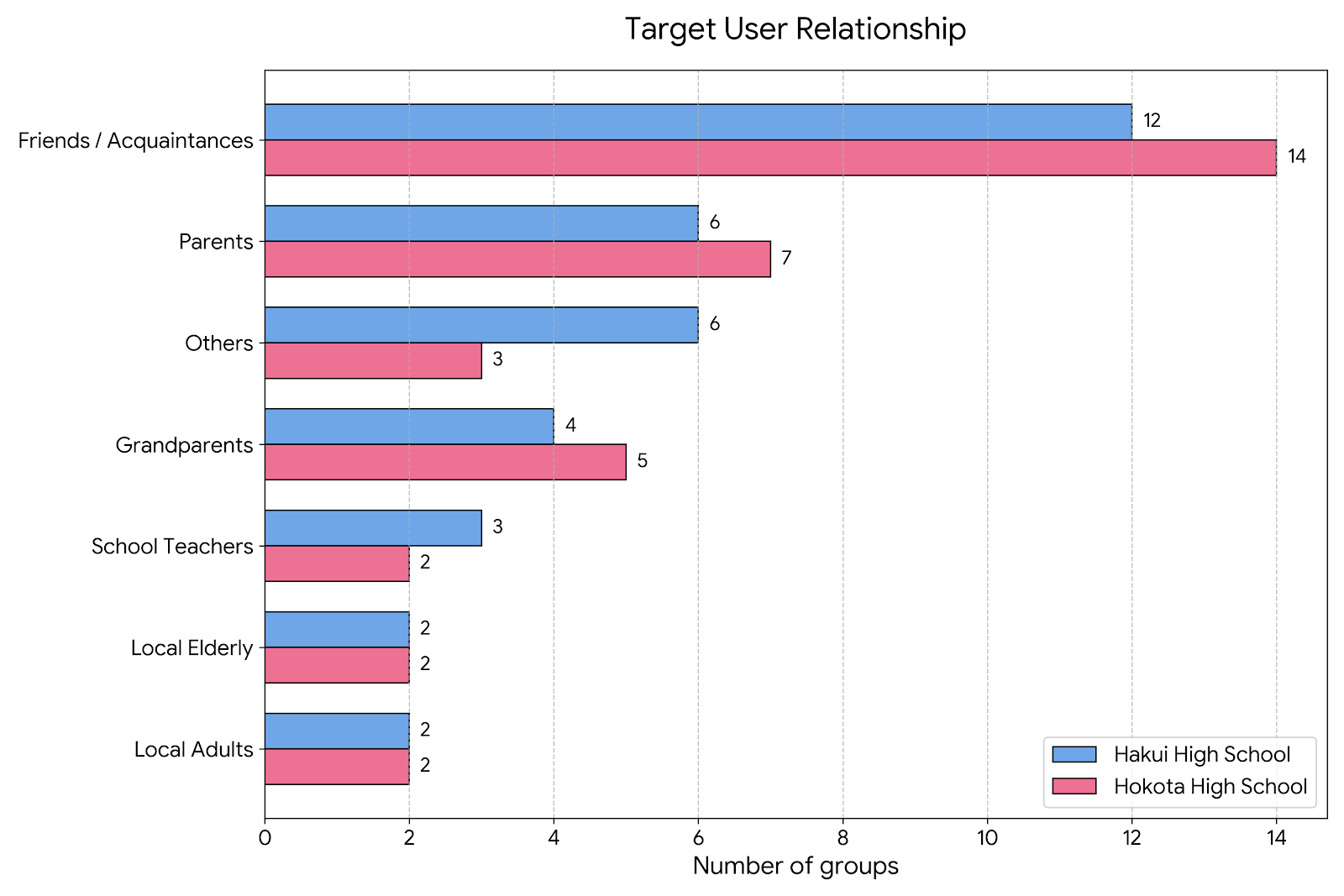
Figure 1. To whom the students created their apps for
As illustrated in Figure 1, the problem-identification process predominantly centered on individuals within the students’ immediate social circles, including peers, parents, and other daily acquaintances.
Across both Hakui and Hokota High Schools, the applications developed by students illustrate a profound engagement with their immediate social and regional environments. Adhering to the program’s core methodology, the cohorts eschewed generalized consumer markets to address highly specific “Wagamama”—deeply personal concerns belonging to well-defined individuals in their daily lives. The resulting technological artifacts demonstrate a localized, empathetic approach to software design that primarily clusters into three overlapping domains: family and intergenerational support, peer-to-peer optimization, and community or institutional logistics.
A significant portion of the students’ computational action was directed toward alleviating the daily friction experienced by their families and older community members. To support grandparents and local elderly residents, students designed tools prioritizing physical safety and social connection, such as medication trackers with high-contrast, accessible interfaces and modified transit timetables. They also engineered safety-mapping applications that identify daytime tripping hazards or well-lit nighttime walking routes, alongside community-bridging platforms meant to mitigate elderly isolation. Concurrently, to reduce the cognitive load on their parents, students developed highly specific household management applications. These included AI-driven recipe generators that utilize leftover ingredients, digital lunchbox coordination systems, and real-time transportation schedulers to manage complex extracurricular pick-up routines.
Looking inward, students also engineered tools to optimize their own lives and provide emotional or academic support to their peers. Addressing the shared pressures of high school, they built gamified collaborative study timers for local exams, sleep management tools, and financial trackers designed to curb impulse spending. Demonstrating a high degree of empathy, some students moved beyond productivity to create private emotion-tracking systems, allowing close friends to silently signal when they are feeling overwhelmed during the school day.
Finally, the students addressed broader social connections and institutional bottlenecks. They developed private communication boards for geographically distributed families, intelligent outing schedulers integrating local weather data, and localized platforms for young parents to connect. Within the school environment itself, they tackled administrative friction by designing digital inventory trackers for club equipment and automated scheduling tools aligned with teacher availability. Collectively, this diverse array of applications highlights the students’ capacity to translate localized, empathetic observations into functional, scalable systemic improvements.
Conclusion
In conclusion, Wagamama Lab showed that even in large-scale public school settings, students can engage with the needs of specific others, design technological responses, and test the meaning of those responses. For Japanese high school education, this offers one pathway for developing the required inquiry period into deeper and more practical learning. It can also be positioned as a practical case showing how a curriculum based on Constructionism and Computational Action can be implemented under real school conditions.
Reference
[1] Ministry of Education, Culture, Sports, Science and Technology. (2018, July). High school curriculum guidelines (notified in 2018) commentary: Comprehensive inquiry time section. https://www.mext.go.jp/component/a_menu/education/micro_detail/__icsFiles/afieldfile/2019/11/22/1407196_21_1_1_2.pdf
[2] Yamada, M. (2023, March). 「総合的な探究の時間」の実態 −探究と教科の連携は進んでいるのか− [The reality of period for “inquiry-based cross-disciplinary study”: Is there progress between inquiry and each subject?]. University of Tokyo. https://scicom.c.u-tokyo.ac.jp/wp/wp-content/uploads/2023/04/2022_10_yamada.pdf
[3] Seymour Papert. 1980. Mindstorms: children, computers, and powerful ideas. Basic Books, Inc., USA.
[4] Mike Tissenbaum, Josh Sheldon, and Hal Abelson. 2019. From computational thinking to computational action. Commun. ACM 62, 3 (March 2019), 34–36. https://doi.org/10.1145/3265747
[5] Irodori Inc. (n.d.). Local STEAM: Inquiry Through Computational Action. Retrieved May 4, 2026, from https://hip-astronomy-a91.notion.site/STEAM-23f03c1a61508032b278c88ae26e5c85
wagamama Lab